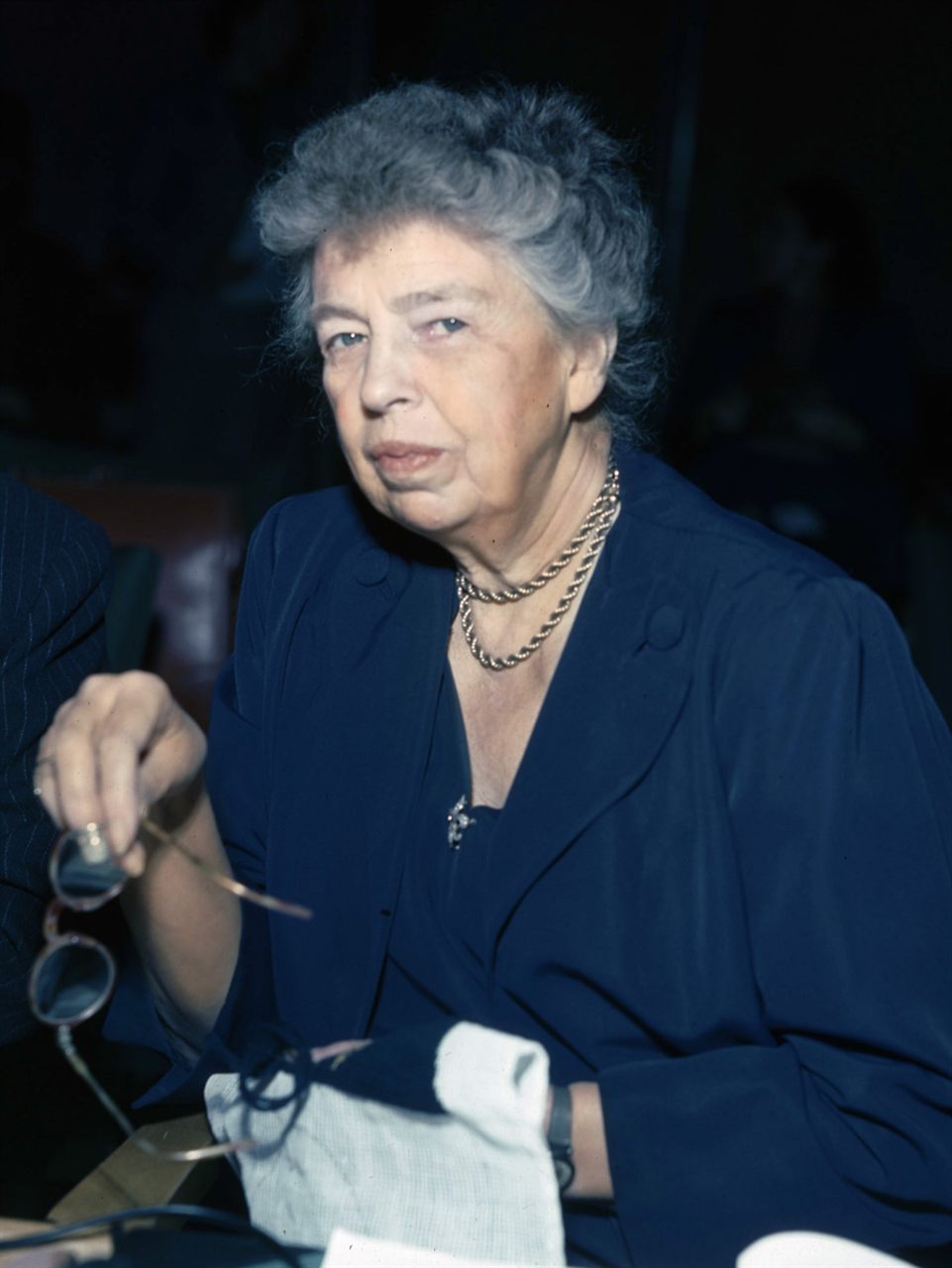
Eleanor Roosevelt
First Lady of the World
Transformational First Lady and diplomat who chaired the committee that drafted the Universal Declaration of Human Rights.
Life at a glance
Key contributions
- Transformed the First Lady role into active social investigation and advocacy
- Chaired the UN work that produced the Universal Declaration of Human Rights
- Defended civil rights, women’s rights, and economic dignity in public life
- Built cross-cultural diplomatic coalitions in the early United Nations
- Gave the world a portable language of universal human dignity
Notable works, inventions and offices
Universal Declaration of Human Rights (1948)
Still standsLife and career
Eleanor Roosevelt (1884–1962) reinvented the role of First Lady through investigation of conditions, press conferences, and advocacy for the poor, women, and civil rights—often ahead of her husband Franklin’s political caution.
After his death she became a U.S. delegate to the United Nations and chaired the commission that produced the Universal Declaration of Human Rights (1948). She built coalitions across cultures to write a shared vocabulary of dignity for the postwar world.
Her famous claim that human rights begin in ‘small places, close to home’ made the UDHR more than diplomatic prose: a checklist for neighborhoods, workplaces, and schools.
She remains the model of how soft power, persistence, and moral imagination can institutionalize conscience at global scale.
Legacy and impact
A shared vocabulary of human dignity for the postwar world.
- Authoritarian pushback makes the UDHR a living battlefield.
Principles and words
View of humanity
Every person everywhere holds inherent rights no state may justly erase.
How we should operate
Write rights into institutions. Show up in places of suffering.
- Human rights as universal
- Dignity of work and social security
- Democracy requires active citizens
- Rights begin in small places close to home
“Where, after all, do universal human rights begin? In small places, close to home…”
Sources
Every statement on this page traces to Wikipedia, Wikidata, Wikiquote, or the curated Humanity’s Atlas record. Nothing is invented. Same standard for everyone: contributions first, neutral language.