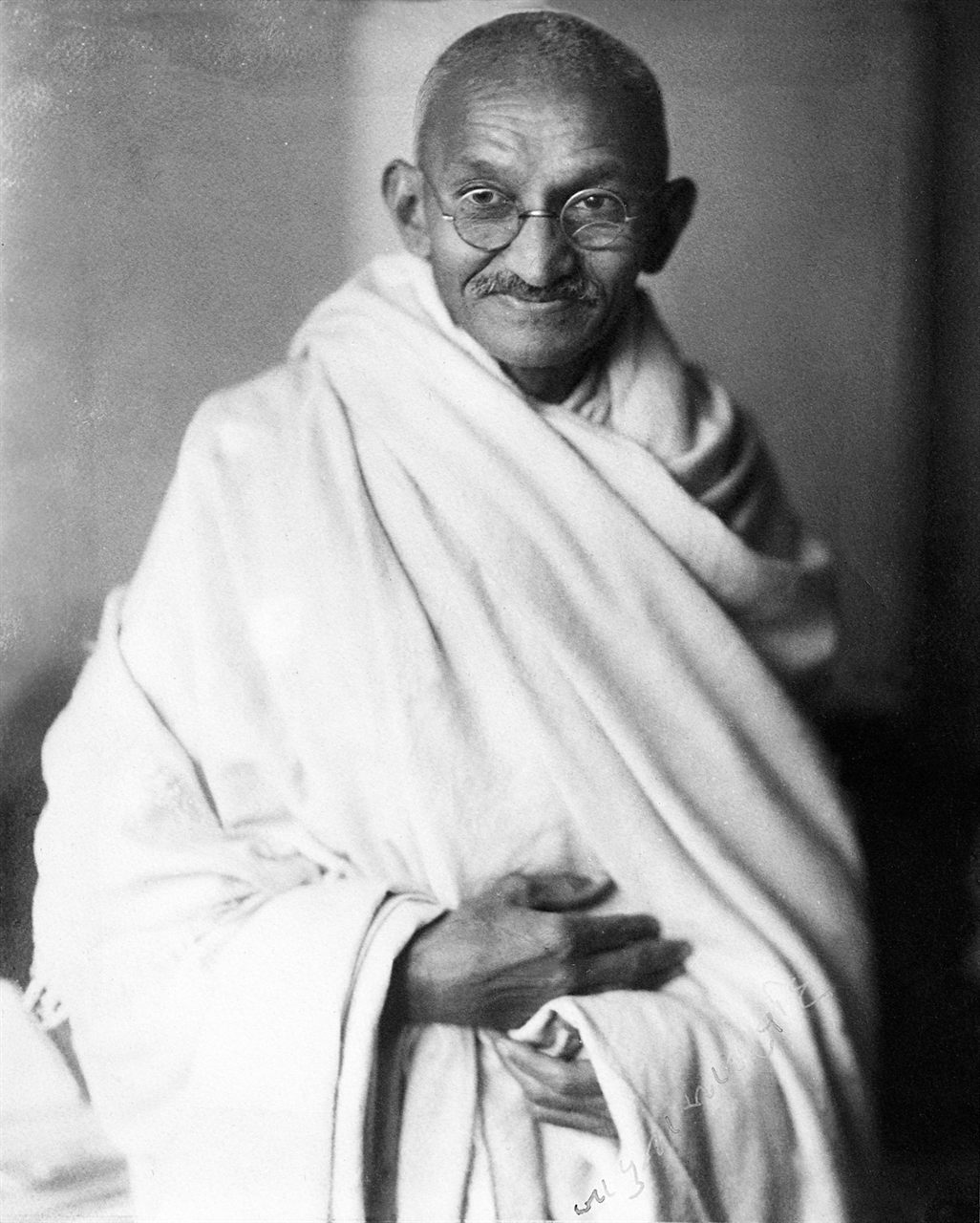
Mohandas K. Gandhi
Mahatma — Great Soul
Leader of India’s independence movement who developed satyagraha—nonviolent resistance grounded in truth-force.
Life at a glance
Key contributions
- Developed satyagraha as a systematic method of nonviolent resistance
- Led mass campaigns that made Indian independence a moral and political necessity
- Elevated ahimsa (non-harm) from personal ethic to political strategy
- Modeled self-mastery (diet, simplicity, discipline) as the root of self-rule
- Inspired worldwide civil-rights and anti-colonial movements
Notable works, inventions and offices
Satyagraha as political method
Living ideaLife and career
Mohandas Karamchand Gandhi (1869–1948) trained as a lawyer in London and developed his method of satyagraha—truth-force—while fighting racial discrimination in South Africa. Returning to India, he transformed the independence movement into a mass ethical campaign.
Noncooperation, salt marches, boycotts, and fasts linked personal discipline (swaraj as self-rule of the self) to national liberation. He insisted that means determine ends: violence would poison the freedom it claimed to win.
Gandhi’s leadership helped make British rule politically untenable, though partition and communal bloodshed marked independence in 1947. He was assassinated in 1948 by a Hindu nationalist who rejected his pluralism and restraint.
His global legacy is the portable toolkit of nonviolent resistance—used by King, Mandela’s generation of activists, and countless local movements that treat moral means as strategic, not optional.
Legacy and impact
Moral means at the center of modern revolution.
- Protest movements still choose between spectacle violence and disciplined nonviolence.
Principles and words
View of humanity
Humans can convert opponents through voluntary suffering and moral clarity.
How we should operate
Organize mass discipline without hatred. Accept legal consequences as part of protest.
- Satyagraha — truth-force
- Ahimsa — non-harm as power
- Means determine ends
- Self-rule begins with self-mastery
“In a gentle way, you can shake the world.”
Sources
Every statement on this page traces to Wikipedia, Wikidata, Wikiquote, or the curated Humanity’s Atlas record. Nothing is invented. Same standard for everyone: contributions first, neutral language.