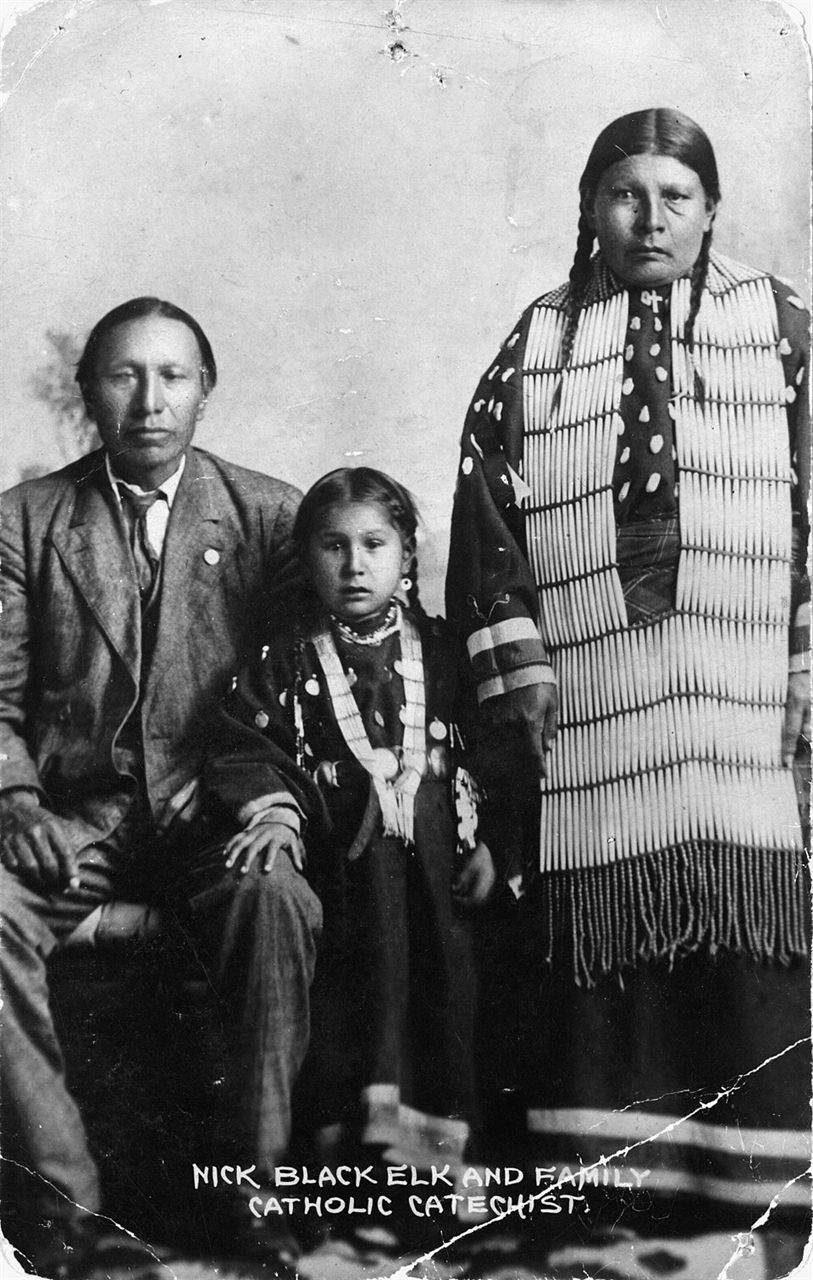
Black Elk (Heȟáka Sápa)
Lakota visionary of the hoop
Holy man who saw a great vision as a boy, survived Wounded Knee, and late in life gave the world Black Elk Speaks—a theology of the broken and still-living hoop of the nation.
Life at a glance
Key contributions
- Received and transmitted a great Lakota vision
- Survived the era of Wounded Knee as a teacher
- Helped carry Lakota cosmology into world literature
- Held Native and Christian practice in one difficult life
- Gave the hoop as an image of collective healing
Notable works, inventions and offices
Black Elk Speaks / Lakota vision tradition
Still standsTestimony of vision and history. Today: A primary text of Native American spirituality worldwide.
Life and career
Black Elk fought as a young man, performed in Europe, became a Catholic catechist, and still carried the great vision of the six grandfathers. John Neihardt’s book (with all its editorial problems) brought Lakota cosmology into world literature.
The hoop is broken, he said, but it can be mended. That is both lament and program.
He stands at the meeting of Native sacrament and the century that tried to end it.
Legacy and impact
The broken hoop as a world symbol of a wounded people still praying.
- Healing of nations still uses his image of the hoop.
Principles and words
View of humanity
A people is a sacred hoop; scattering it is a cosmic injury.
How we should operate
Tell the vision. Plant the tree at the center again.
- The hoop of the nation can be mended
- Vision is a public trust
- Two roads of faith may meet in one life
- The center is a tree that must live
“The sacred hoop of my people was one of many hoops that made one circle.”
Sources
Every statement on this page traces to Wikipedia, Wikidata, Wikiquote, or the curated Humanity’s Atlas record. Nothing is invented. Same standard for everyone: contributions first, neutral language.