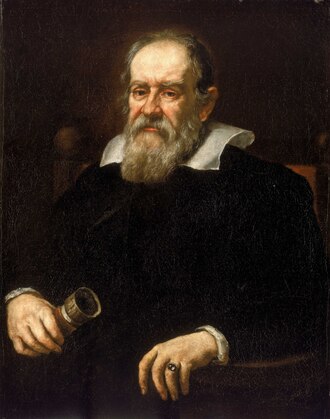
Galileo Galilei
Father of Modern Observational Science
Physicist and astronomer who turned the telescope on the heavens, defended Copernicanism, and established experiment and mathematics as the language of nature—despite trial by the Inquisition.
Life at a glance
Key contributions
- Pioneered telescopic astronomy and discovered Jupiter’s moons
- Provided decisive evidence for the Copernican framework
- Founded key principles of classical kinematics and scientific method
- Wrote public scientific arguments that reshaped educated Europe
- Became the enduring symbol of free inquiry under institutional pressure
Notable works, inventions and offices
Telescopic astronomy & Two New Sciences
Still standsObservational discoveries and physics texts. Today: Scientific method culture.
Life and career
Galileo Galilei (1564–1642) turned the telescope on the sky and saw moons of Jupiter, phases of Venus, and a rugged Moon—evidence that cracked Aristotelian heavens. He advanced kinematics of falling bodies and the ideal of mathematical physics.
His advocacy of Copernicanism collided with church authority; trial and house arrest made him a symbol of science under power. Dialogue and Discourse taught a new public to think mechanically about nature.
Galileo’s method—instrument, experiment, geometry—became the house style of modern science. He wrote in Italian as well as Latin to reach beyond specialists.
He remains the emblem of seeing for oneself and paying the cost when institutions fear what is seen.
Legacy and impact
Science as a public, instrumented confrontation with reality.
- Science communication under political pressure remains Galilean.
Principles and words
View of humanity
Humans grasp truth by measuring, not only by quoting.
How we should operate
Build instruments. Publish results. Protect dissent in science.
- Experiment over pure authority
- Mathematics as nature’s language
- Public demonstration of evidence
- Intellectual courage under power
“And yet it moves.”
Sources
Every statement on this page traces to Wikipedia, Wikidata, Wikiquote, or the curated Humanity’s Atlas record. Nothing is invented. Same standard for everyone: contributions first, neutral language.