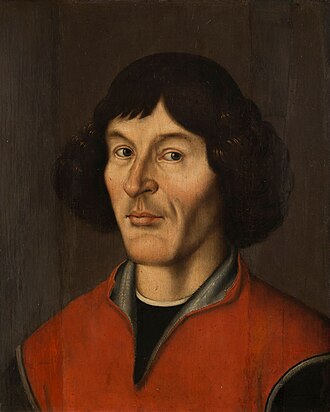
Nicolaus Copernicus
Author of the Heliocentric Shift
Astronomer who proposed that Earth and planets revolve around the Sun—displacing the Earth from the cosmic center and enabling modern astronomy.
Life at a glance
Key contributions
- Formulated the modern heliocentric model of the solar system
- Authored De revolutionibus, a foundational scientific classic
- Initiated the Copernican Revolution in astronomy and worldview
- Improved planetary mathematics that later enabled Kepler’s laws
- Decentered Earth in a way that remade science and philosophy
Notable works, inventions and offices
De revolutionibus orbium coelestium
Still standsHeliocentric treatise. Today: Foundation of modern astronomy.
Life and career
Nicolaus Copernicus (1473–1543), Polish astronomer and canon, developed a heliocentric model that placed the Sun near the center of planetary motions. His De revolutionibus was published as he lay dying.
Building on earlier data and geometric ingenuity, he challenged the Earth-centered cosmos of Ptolemy without yet having a full physics of motion. The book’s slow fuse lit Galileo, Kepler, and Newton.
Copernicus worked carefully within church structures even as his idea unsettled them. The scientific revolution’s first great decentering of humanity’s cosmic privilege bears his name.
His accomplishment is intellectual courage through mathematics: let the model fit the heavens, even if it wounds common sense.
Legacy and impact
The cosmic decentering of the human.
- Every GPS satellite rides on post-Copernican physics.
Principles and words
View of humanity
Humans are not geometrically central—but they can understand a vast order.
How we should operate
Let evidence revise sacred cosmologies carefully but honestly.
- Mathematical elegance as guide to nature
- Courage to displace human centrality
- Observation reforming tradition
- Cosmos as orderly system
“To know that we know what we know, and to know that we do not know what we do not know, that is true knowledge.”
Sources
Every statement on this page traces to Wikipedia, Wikidata, Wikiquote, or the curated Humanity’s Atlas record. Nothing is invented. Same standard for everyone: contributions first, neutral language.