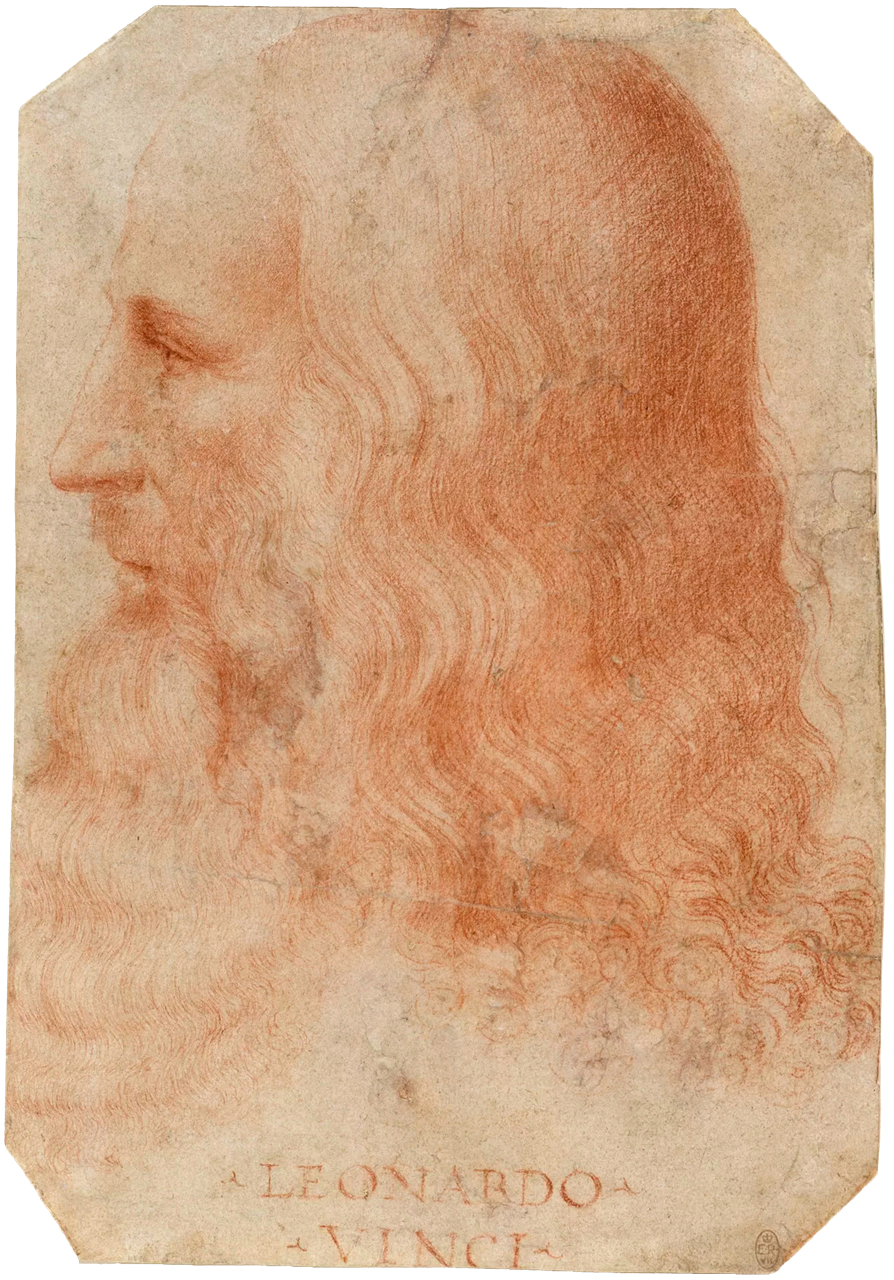
Leonardo da Vinci
Universal Mind of the Renaissance
Artist, engineer, anatomist, and observer whose notebooks fused art and science in a single disciplined curiosity about how the world works.
Life at a glance
Key contributions
- Created enduring masterpieces including the Mona Lisa and Last Supper
- Filled notebooks that fused art, anatomy, engineering, and natural science
- Advanced observational methods in anatomy and fluid study
- Designed machines and concepts centuries ahead of fabrication capacity
- Modeled unified inquiry: art and science as one disciplined curiosity
Notable works, inventions and offices
Notebooks & anatomical studies
Partially remainsLife and career
Leonardo da Vinci (1452–1519) apprenticed in Florence under Verrocchio and worked in Milan, Florence, Rome, and finally France. He painted few finished masterpieces relative to his fame, but those—including the Last Supper and Mona Lisa—redefined Western art’s ambition.
His true archive is the notebooks: thousands of pages on anatomy, flight, hydraulics, machines, optics, and geology. He dissected corpses, mapped vortices of water, and designed war engines and flying devices, treating observation as higher authority than inherited dogma.
Leonardo refused the wall between art and science. Drawing was a way of thinking; beauty and mechanism revealed the same nature. His unfinished projects show a mind always mid-question.
He remains the emblem of Renaissance curiosity as vocation—disciplined wonder without compartment walls—still the gold standard for interdisciplinary genius.
Legacy and impact
Curiosity itself as a vocation.
- STEM/arts divides still impoverish education.
Principles and words
View of humanity
Humans understand themselves by studying the whole of nature.
How we should operate
Keep sketchbooks of the real. Cross disciplines.
- Observation before authority
- Art and science as one inquiry
- Curiosity without compartment walls
- Nature as the true teacher
“Learning never exhausts the mind.”
Sources
Every statement on this page traces to Wikipedia, Wikidata, Wikiquote, or the curated Humanity’s Atlas record. Nothing is invented. Same standard for everyone: contributions first, neutral language.