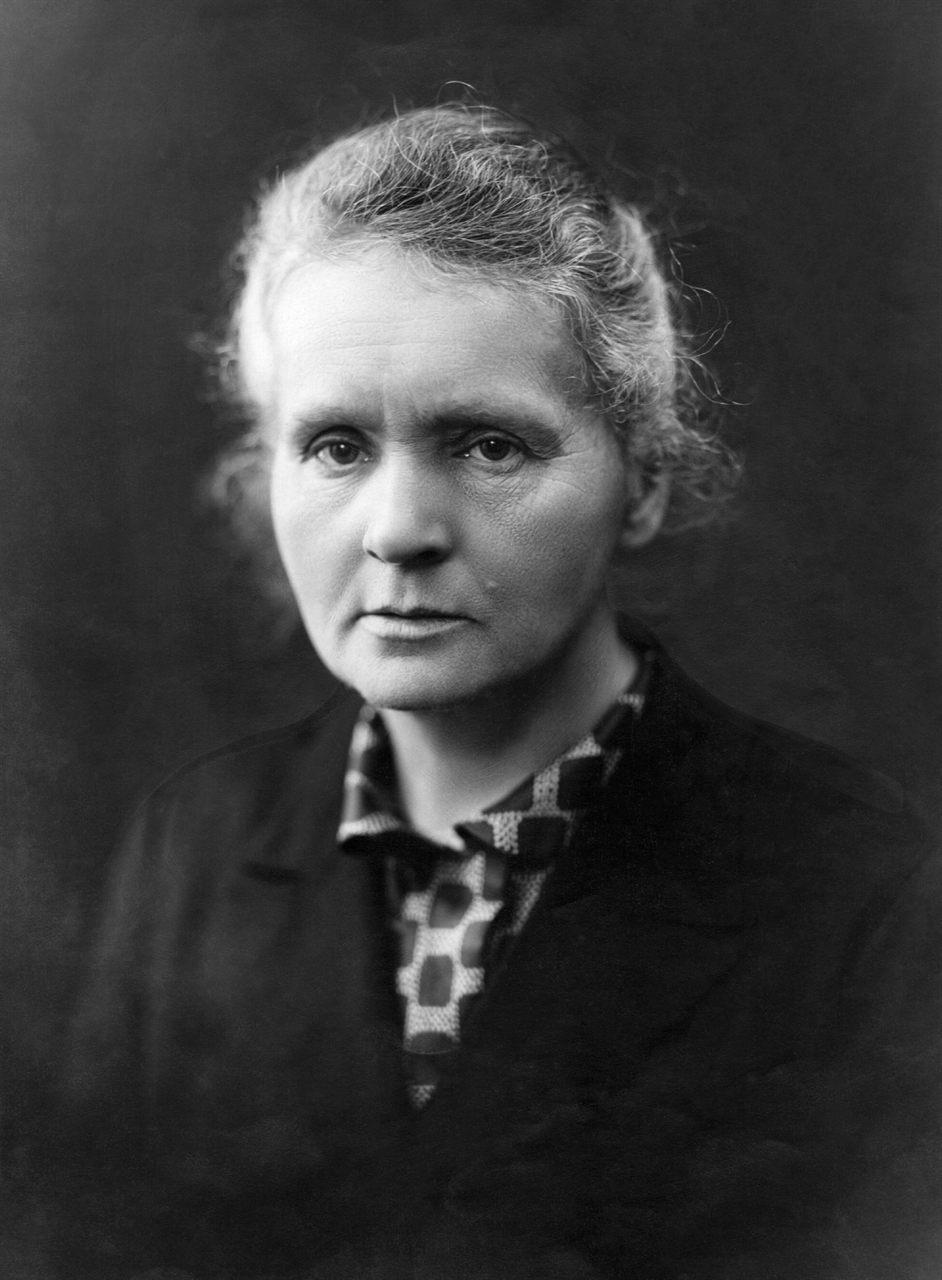
Marie Skłodowska Curie
Pioneer of Radioactivity
Physicist and chemist who discovered polonium and radium, won two Nobel Prizes in different sciences, and brought X-ray technology to the WWI front.
Life at a glance
Key contributions
- Discovered polonium and radium and coined the framework of radioactivity research
- Won Nobel Prizes in both Physics and Chemistry—the first dual science laureate
- Advanced medical applications of radiation and X-ray technology
- Brought mobile X-ray units to WWI fronts, saving countless wounded
- Opened institutional paths for women in advanced scientific research
Notable works, inventions and offices
Discovery of radium & polonium
Living ideaLife and career
Marie Skłodowska Curie (1867–1934) left partitioned Poland for Paris because higher scientific education was closed to her at home. With Pierre Curie she investigated radioactivity—a term she coined—and isolated polonium and radium under grueling laboratory conditions.
She won the 1903 Nobel Prize in Physics (shared) and the 1911 Nobel in Chemistry, becoming the first person awarded Nobels in two sciences. After Pierre’s death she continued research, taught, and built institutions for radioactive study.
In World War I she equipped mobile X-ray units (‘Little Curies’) and trained operators near the front, linking pure discovery to battlefield medicine. She died of illness linked to radiation exposure in an era that did not yet understand the cost.
Curie embodies science as international public good and persistence against exclusion—truth through experiment in service of healing.
Legacy and impact
The laboratory linked to the hospital and the battlefield clinic.
- Women in STEM remain an unfinished agenda.
Principles and words
View of humanity
Prejudice that excludes talent is unjust and scientifically wasteful.
How we should operate
Fund basic research. Open labs to talent regardless of gender or origin.
- Truth through experiment
- Science as international public good
- Persistence against exclusion
- Knowledge must serve healing
“Nothing in life is to be feared, it is only to be understood.”
Sources
Every statement on this page traces to Wikipedia, Wikidata, Wikiquote, or the curated Humanity’s Atlas record. Nothing is invented. Same standard for everyone: contributions first, neutral language.