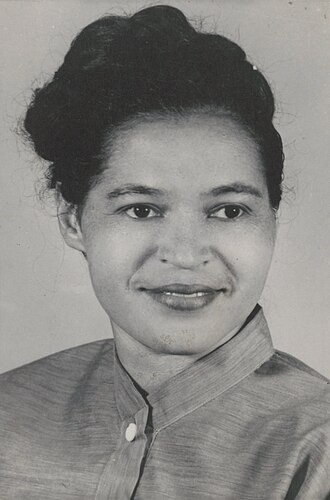
Rosa Parks
Spark of the Montgomery Bus Boycott
Organized activist whose refusal to yield a bus seat in 1955 catalyzed the Montgomery Bus Boycott—proving disciplined mass noncooperation could crack legal segregation.
Life at a glance
Key contributions
- Sparked the Montgomery Bus Boycott by refusing unjust segregation
- Helped catalyze the modern Civil Rights Movement’s mass phase
- Modeled disciplined, dignified nonviolent resistance
- Served long-term as NAACP activist and community organizer
- Became a worldwide symbol of everyday courage against racist law
Notable works, inventions and offices
Montgomery Bus Boycott catalyst
TransformedMass nonviolent campaign against segregated buses. Today: Civil rights strategy textbook.
Life and career
Rosa Parks (1913–2005) was a seasoned NAACP activist in Montgomery, Alabama—not merely a tired seamstress—when she refused to give up her bus seat to a white passenger on December 1, 1955. Her arrest sparked the Montgomery Bus Boycott.
For 381 days the Black community organized carpools and walked, proving economic and moral power. The boycott brought King to national leadership and ended bus segregation by court order.
Parks continued civil-rights work for decades, often under financial hardship. Her quiet firmness became a global icon of dignified resistance.
Her accomplishment is the spark that made a movement unstoppable—and the long discipline behind a single ‘no.’
Legacy and impact
The quiet act that opened a movement’s throttle.
- Everyday discrimination still needs Parks-level prepared refusal.
Principles and words
View of humanity
Oppression is enforced in ordinary seats and sidewalks; freedom begins there too.
How we should operate
Train activists. Choose symbolic battles that communities can sustain.
- Dignity in everyday public space
- Prepared courage, not impulse alone
- Mass economic noncooperation
- Local organization as national lever
“People always say that I didn't give up my seat because I was tired, but that isn't true… I was tired of giving in.”
Sources
Every statement on this page traces to Wikipedia, Wikidata, Wikiquote, or the curated Humanity’s Atlas record. Nothing is invented. Same standard for everyone: contributions first, neutral language.