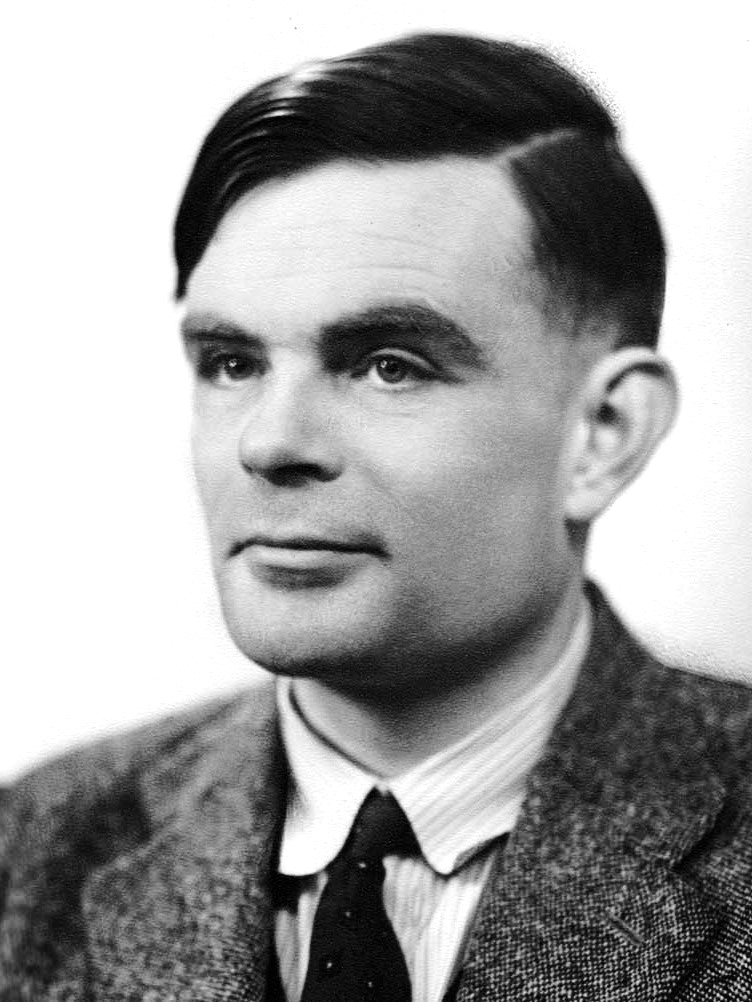
Alan Turing
Founder of Computer Science
Mathematician who formalized computation, helped crack Axis codes, and imagined machine intelligence
Life at a glance
Key contributions
- Founded theoretical computer science with the Turing machine concept
- Played a central role in breaking Nazi Enigma codes in WWII
- Pioneered artificial intelligence questions via the Turing Test
- Contributed to early electronic computing design and morphogenesis math
- Became a symbol of LGBTQ injustice and posthumous recognition
Notable works, inventions and offices
Turing machine concept & wartime cryptanalysis
Living ideaFoundations of computing and AI questions. Today: Every computer and chatbot.
Life and career
Alan Turing (1912–1954) was a British mathematician who formalized computation with the Turing machine—the conceptual core of computer science. During WWII he was central to breaking Enigma at Bletchley Park, shortening the war and saving lives.
He proposed the Turing Test for machine intelligence and worked on early computing and morphogenesis. Prosecuted for homosexuality, he suffered chemical castration and died in 1954; the state later apologized and pardoned him.
Every smartphone and server is a descendant of his abstraction. His life also indicts the cruelty of the society he helped save.
His accomplishment is the theoretical and practical founding of the digital age.
Legacy and impact
The digital age’s quiet founder.
- AI ethics and queer rights both sit in Turing’s shadow.
Principles and words
View of humanity
Humans can externalize thought into machines—and must not destroy the thinkers who do.
How we should operate
Build computing as public infrastructure. Protect LGBTQ scientists and citizens as a moral and talent imperative.
- Mind as implementable process
- Formal clarity about algorithms
- Science serving survival of free societies
- Human dignity independent of prejudice
“We can only see a short distance ahead, but we can see plenty there that needs to be done.”
Sources
Every statement on this page traces to Wikipedia, Wikidata, Wikiquote, or the curated Humanity’s Atlas record. Nothing is invented. Same standard for everyone: contributions first, neutral language.