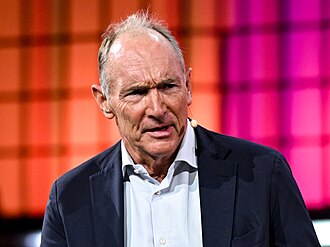
Tim Berners-Lee
Inventor of the World Wide Web
Computer scientist who invented the World Wide Web’s core technologies and chose openness—creating the universal information space that reordered commerce, politics, and knowledge.
Life at a glance
Key contributions
- Invented the World Wide Web (HTTP, HTML, URLs, first browser/server)
- Released the web as open, non-proprietary technology
- Founded the W3C to steward open web standards
- Enabled the global information and commerce ecosystem of the modern era
- Advocates ongoing for a human-centered, open internet
Notable works, inventions and offices
World Wide Web (HTML/HTTP/URL)
Still standsFoundational web stack. Today: The default layer of global communication.
Life and career
Tim Berners-Lee (b. 1955) invented the World Wide Web at CERN in 1989–91: HTTP, HTML, URLs, and the first browser-server system so scientists could share documents across networks. Crucially, he and CERN released the web as open technology rather than a proprietary silo.
He founded the World Wide Web Consortium (W3C) to keep standards open and has advocated for net neutrality, data rights, and a web that serves humanity rather than only platforms.
The web’s later problems—surveillance, monopoly, misinformation—do not erase the gift of a universal linked information space. Few individuals have so scaled human communication.
His accomplishment is the shared canvas on which modern knowledge and culture now paint.
Legacy and impact
Gutenberg’s explosion, networked.
- Platform monopolies and AI scrapers test whether the web stays open.
Principles and words
View of humanity
Humans think better when anyone can publish and anyone can read—if power does not capture the pipes.
How we should operate
Defend open protocols. Design platforms that serve users, not only advertisers.
- Universal access to linked information
- Open standards over private cages
- Decentralization of publishing
- Human control of personal data
“This is for everyone.”
Sources
Every statement on this page traces to Wikipedia, Wikidata, Wikiquote, or the curated Humanity’s Atlas record. Nothing is invented. Same standard for everyone: contributions first, neutral language.