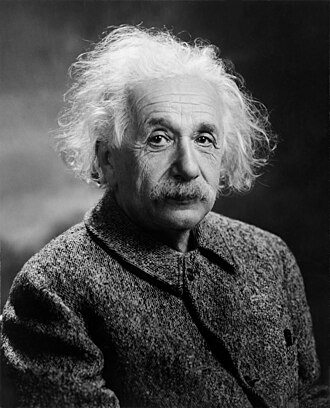
Albert Einstein
Reweaver of Space, Time & Energy
Physicist who reshaped space, time, gravity, and energy with relativity—and used his fame to defend pacifism, civil rights, and internationalism after fleeing Nazism.
Life at a glance
Key contributions
- Created special and general relativity, remaking physics
- Explained the photoelectric effect, aiding quantum theory’s rise
- Became the global symbol of scientific genius and moral conscience
- Predicted phenomena confirmed from eclipses to gravitational waves
- Advocated internationalism and civil rights as a public intellectual
Notable works, inventions and offices
Special & general relativity
Still standsFoundational spacetime physics. Today: GPS, cosmology, nuclear age.
Life and career
Albert Einstein (1879–1955) transformed physics with special and general relativity, explaining the photoelectric effect (Nobel 1921) in ways that supported quantum theory even as he later debated its completeness. E=mc² entered culture as the emblem of scientific power.
A German-born Jew, he fled Nazism, settled in the U.S., warned of nuclear weapons, and became a public voice for pacifism, civil rights, and internationalism—imperfectly navigating the atomic age he helped make possible.
General relativity’s curved spacetime predicted phenomena from Mercury’s orbit to black holes and gravitational waves later observed. Cosmology still speaks his equations.
His accomplishment is a new architecture of space, time, gravity, and energy—and the model of the scientist as global citizen.
Legacy and impact
The scientist as cosmic thinker and public conscience.
- AI and biotech face Einstein’s problem: power without wisdom.
Principles and words
View of humanity
Humans can grasp cosmic order—and must not let technical power outrun moral maturity.
How we should operate
Fund pure research. Tie scientific prestige to peace and human rights.
- Reality is stranger than common sense
- Unity of natural laws
- Science with social responsibility
- Imagination as scientific instrument
“Imagination is more important than knowledge.”
Sources
Every statement on this page traces to Wikipedia, Wikidata, Wikiquote, or the curated Humanity’s Atlas record. Nothing is invented. Same standard for everyone: contributions first, neutral language.