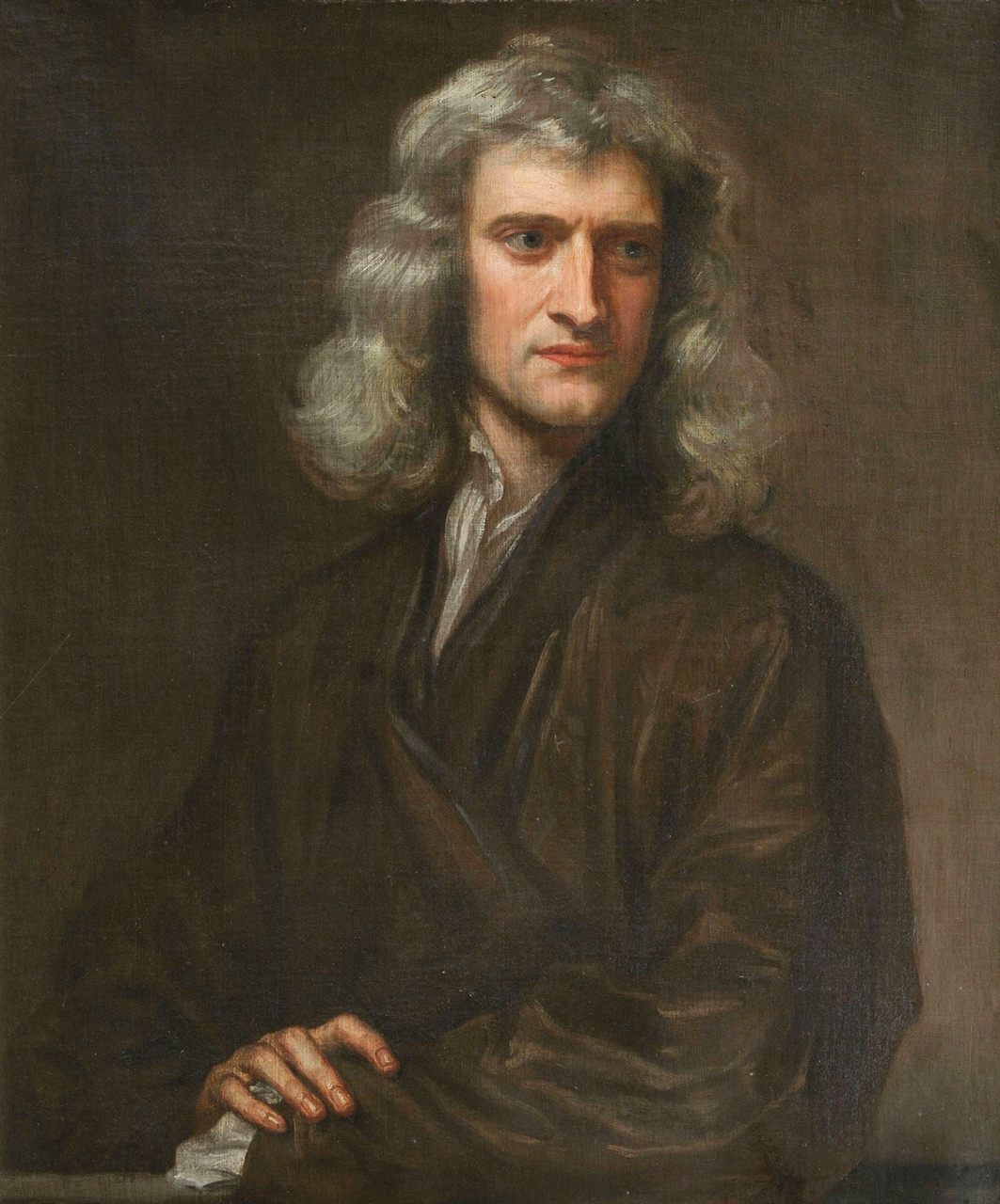
Isaac Newton
Architect of Classical Physics
Formulated laws of motion and universal gravitation, co-invented calculus, and wrote the Principia—unifying heavens and earth under one mathematical physics.
Life at a glance
Key contributions
- Formulated the three laws of motion and universal gravitation
- Co-invented calculus as a mathematical language of change
- Transformed optics through experimental study of light and color
- Authored the Principia, founding classical mathematical physics
- Unified celestial and terrestrial mechanics under one framework
Notable works, inventions and offices
Philosophiæ Naturalis Principia Mathematica
Still standsFoundational physics treatise. Today: Engineering, ballistics, orbital mechanics roots.
Life and career
Isaac Newton (1643–1727) formulated the laws of motion and universal gravitation, invented calculus (in priority dispute with Leibniz), and transformed optics with experiments on light and color. The Principia (1687) set the gold standard of mathematical physics.
He explained Kepler’s planetary laws with a single inverse-square force and terrestrial falling with the same principle—unifying heaven and earth. At the Mint and in later years he also pursued alchemy and biblical chronology, a reminder that genius is not only modern.
Newtonian mechanics powered engineering and astronomy until relativity and quantum theory limited its domain—without erasing its daily utility.
His accomplishment is the classical universe as a knowable machine of law.
Legacy and impact
The clockwork cosmos—and the method that later overthrew it.
- Spaceflight and structural engineering still speak Newtonian for everyday scales.
Principles and words
View of humanity
The universe is intelligible; human reason can decode its laws.
How we should operate
Unify domains with shared principles. Demand quantitative test.
- Universal laws expressible in math
- Same physics for apple and moon
- Hypothesis disciplined by phenomena
- Standing on giants’ shoulders
“If I have seen further it is by standing on the shoulders of Giants.”
Sources
Every statement on this page traces to Wikipedia, Wikidata, Wikiquote, or the curated Humanity’s Atlas record. Nothing is invented. Same standard for everyone: contributions first, neutral language.