Hammurabi
Lawgiver of Babylon
Sixth king of the First Babylonian Dynasty who unified much of Mesopotamia and promulgated one of the earliest comprehensive written law codes.
Life at a glance
Key contributions
- Unified much of southern Mesopotamia under Babylonian rule
- Promulgated one of history’s earliest comprehensive written law codes
- Standardized legal and commercial norms across a multi-city empire
- Built and maintained irrigation and temple infrastructure as tools of state
- Framed kingship as a duty to make justice prevail for the vulnerable
Notable works, inventions and offices
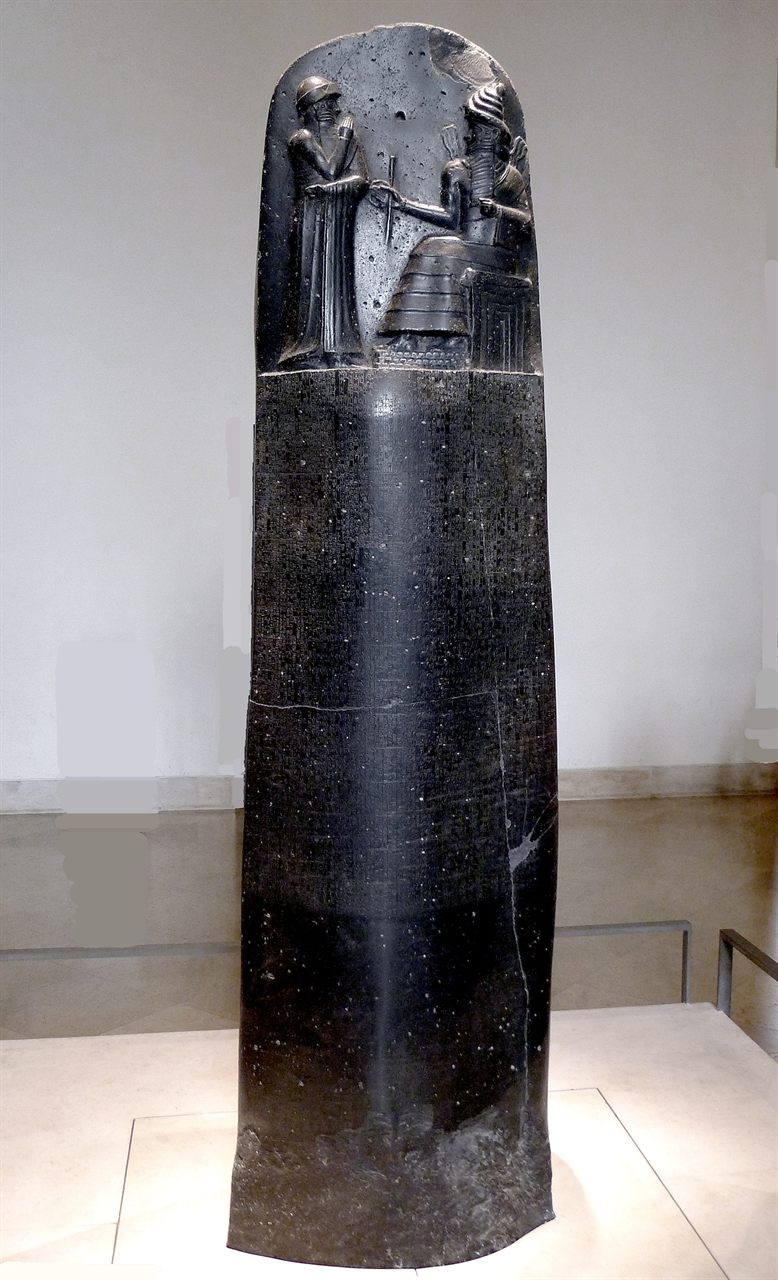
Code of Hammurabi stele
Still standsLife and career
Hammurabi rose in the early second millennium BCE as king of Babylon, then a rising power among the city-states of southern Mesopotamia. Through a long reign of roughly four decades, he combined diplomacy, fortification, and military campaigns to bring rival kingdoms under Babylonian authority, forging one of the most coherent territorial states of the Old Babylonian period.
His administration invested in canals, temples, and the bureaucratic tools of empire: census-taking, provincial governors, and correspondence that still survives on clay tablets. Law and public works were not separate projects; controlling water and controlling conflict were both ways of making a multi-city landscape governable.
The Code associated with his name—inscribed on a diorite stele now in the Louvre—was not the first legal collection in Mesopotamia, but it became the most famous. It presents justice as a public, written instrument: tariffs, family rules, commercial liability, and protections for the weak against the strong, framed as a divine charge to the king.
Whatever the gap between ideal code and daily practice, Hammurabi’s project fixed a civilizational idea: that power should be legible, proportional, and answerable to published norms rather than pure personal whim. That idea echoes whenever modern societies insist that law be knowable and that rulers stand under it.
Legacy and impact
Civilization as the taming of raw power by public norms.
- Rule of law vs. arbitrary power remains the central political question.
Principles and words
View of humanity
Humans are unequal in status yet all live under a moral-legal order.
How we should operate
Communities thrive when justice is published and the strong are restrained.
- Public law over secret custom
- Proportional justice
- Protection of the vulnerable from the powerful
- Written accountability
“…to make justice prevail in the land, to destroy the wicked and the evil…”
Sources
Every statement on this page traces to Wikipedia, Wikidata, Wikiquote, or the curated Humanity’s Atlas record. Nothing is invented. Same standard for everyone: contributions first, neutral language.