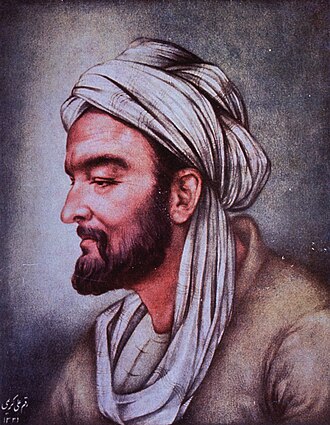
Ibn Sina (Avicenna)
Prince of Physicians
Polymath whose Canon of Medicine and philosophical works shaped medical education from the Islamic world to Europe for centuries.
Life at a glance
Key contributions
- Authored the Canon of Medicine, a millennial medical standard
- Advanced philosophy of being, soul, and intellect in the Islamic tradition
- Synthesized Greek and Islamic scientific learning at the highest level
- Influenced European scholasticism and medical teaching for centuries
- Modeled the physician-philosopher as a single vocation of care and reason
Notable works, inventions and offices
The Canon of Medicine
Still standsMedical encyclopedia. Today: History of medicine curricula; manuscript tradition.
Life and career
Ibn Sina (Avicenna, 980–1037) was a Persian polymath of the Islamic Golden Age—physician, philosopher, and scientist. His Canon of Medicine synthesized Greek and Islamic medical knowledge into a standard textbook used in Eurasia for centuries.
Philosophically he advanced Aristotelian and Neoplatonic thought on the soul, existence, and intellect, influencing both Islamic and later Latin scholasticism. He wrote while serving courts and often under political instability.
His method combined empirical clinical observation with systematic theory. Hospitals and medical education from Baghdad to Europe felt his taxonomy of disease and treatment.
Ibn Sina stands for the cosmopolitan intellect: science and philosophy as a shared human inheritance across languages and faiths.
Legacy and impact
Globalized medical science before the modern hospital.
- Cross-cultural knowledge exchange remains the condition of medical progress.
Principles and words
View of humanity
The body and mind can be understood systematically; healing is a learned craft.
How we should operate
Train physicians with rigorous texts. Preserve and improve knowledge across languages.
- Medicine as rational science
- Observation joined to theory
- Knowledge as public inheritance
- Philosophy serving healing
“The knowledge of anything, since all things have causes, is not acquired or complete unless it is known by its causes.”
Sources
Every statement on this page traces to Wikipedia, Wikidata, Wikiquote, or the curated Humanity’s Atlas record. Nothing is invented. Same standard for everyone: contributions first, neutral language.