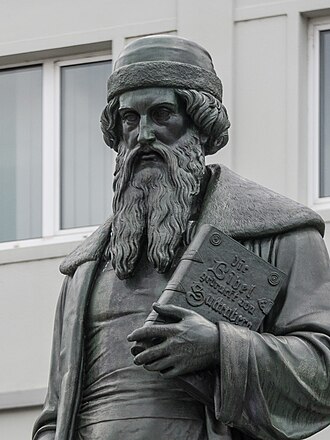
Johannes Gutenberg
Inventor of Movable-Type Printing in Europe
Craftsman who combined movable metal type, oil-based ink, and the press to make books reproducible at scale—igniting mass literacy, Reformation, and science.
Life at a glance
Key contributions
- Invented practical movable-type printing in Europe
- Produced the Gutenberg Bible, a landmark of craft and communication
- Triggered an explosion of literacy and book culture
- Enabled the Reformation and scientific exchange at unprecedented speed
- Created the technical basis of the modern information world
Notable works, inventions and offices
Gutenberg Bible / European letterpress system
Still standsSurviving Bibles and the printing method. Today: Every press, PDF, and blog is a remote descendant.
Life and career
Johannes Gutenberg (c. 1400–1468) of Mainz developed movable-type printing with metal type, oil-based ink, and a press adapted from existing technology—an integrated system more than a single gadget.
His Bible and the rapid spread of print shops across Europe detonated an information revolution: cheaper books, vernacular literacy, scientific correspondence, and religious controversy at scale. The Reformation and the Scientific Revolution rode print’s rails.
Gutenberg himself faced lawsuits and financial trouble; the invention outran the inventor’s fortune. Yet the press became the machine that multiplied minds.
His accomplishment is the industrialization of writing—and with it, modern public opinion.
Legacy and impact
The first great information revolution of the modern world.
- Internet-scale publishing is Gutenberg’s explosion continued.
Principles and words
View of humanity
Humans change when everyone can hold the same page.
How we should operate
Invest in tools that democratize reading. Guard against both monopoly and chaos in information systems.
- Knowledge multiplies when media multiplies
- Craft innovation as civilizational lever
- Text as public infrastructure
- Standardization enables scale
“Religious truth is captive in a small number of little manuscripts…”
Sources
Every statement on this page traces to Wikipedia, Wikidata, Wikiquote, or the curated Humanity’s Atlas record. Nothing is invented. Same standard for everyone: contributions first, neutral language.