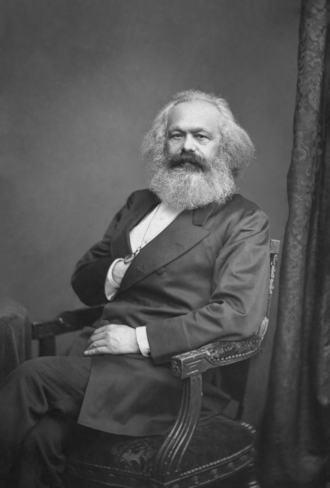
Karl Marx
Analyst of Capitalism & Class
Philosopher and economist who diagnosed industrial capitalism’s dynamics and inspired movements that remade states, labor law, and global politics—for liberation and for catastrophe.
Life at a glance
Key contributions
- Co-authored the Communist Manifesto, a world-changing political text
- Wrote Capital, a foundational critique of political economy
- Developed analytic tools of class, ideology, and historical materialism
- Inspired global labor movements and social-democratic reforms
- Permanently shaped how societies debate inequality and capitalism
Notable works, inventions and offices
Capital / Communist Manifesto
Still standsFoundational critical-political texts. Today: Labor movements, social science, revolutionary history.
Life and career
Karl Marx (1818–1883), German philosopher and economist, co-authored the Communist Manifesto (1848) with Engels and spent decades on Capital, a critique of political economy analyzing capitalism’s dynamics, exploitation, and crises.
He argued that class struggle drives historical change and that capitalism’s productivity coexists with alienation and inequality. His ideas inspired labor movements, revolutions, and states—some liberatory, some catastrophically authoritarian.
Honest assessment separates analytic tools (class, ideology, commodity fetishism) from the crimes of regimes that claimed his name. Few thinkers have so altered politics and social science.
His accomplishment is a language for diagnosing power in the economy that the world still cannot ignore.
Legacy and impact
Made class and capital permanent objects of politics.
- Inequality and automation revive Marxian questions even among non-Marxists.
Principles and words
View of humanity
Humans make history under conditions they do not choose; freedom requires transforming those conditions.
How we should operate
Analyze power in production, not only in parliaments. Measure dignity by labor’s share of life.
- Material conditions shape consciousness
- Class conflict as historical engine
- Critique of exploitation and alienation
- Emancipation through collective action
“The philosophers have only interpreted the world, in various ways; the point is to change it.”
Sources
Every statement on this page traces to Wikipedia, Wikidata, Wikiquote, or the curated Humanity’s Atlas record. Nothing is invented. Same standard for everyone: contributions first, neutral language.