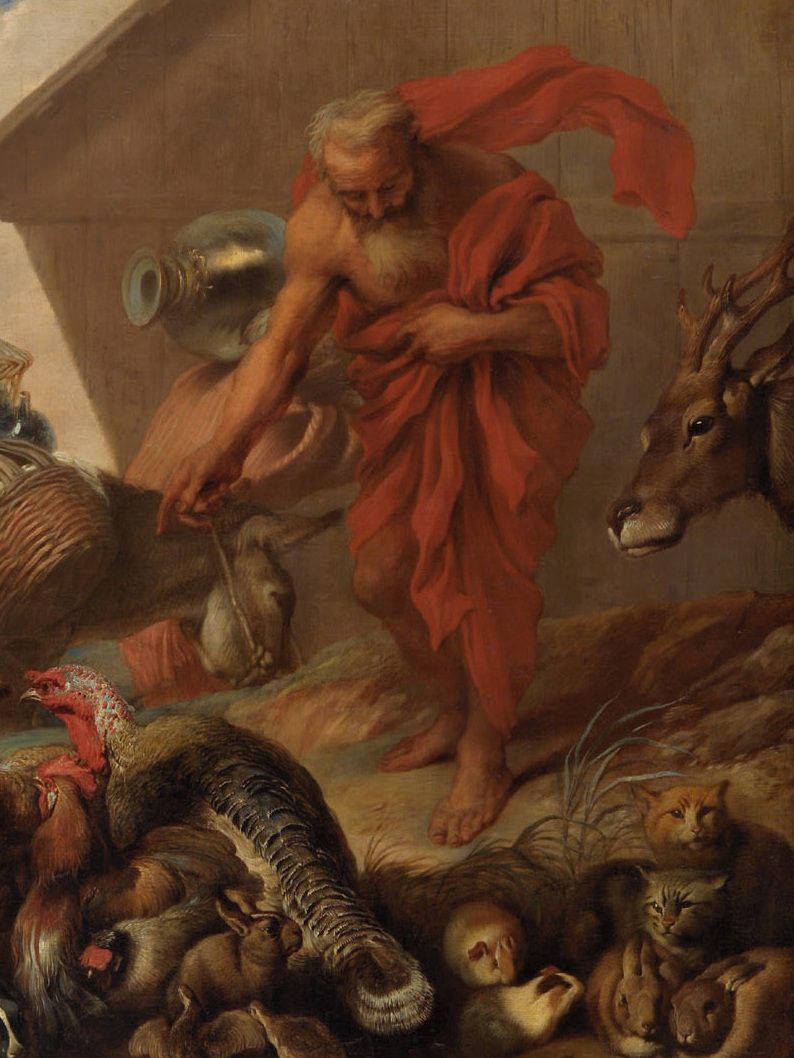
Noah
Preserver of life
The righteous man who built an ark and kept a remnant of life through the flood—humanity’s oldest story of stewardship when the world goes under.
Life at a glance
Key contributions
- Became the scriptural type of the preserver of life
- Carried a remnant through cosmic judgment
- Received a covenant that limits destruction
- Linked human righteousness to the fate of creatures
- Gave three faiths their flood-and-hope story
Notable works, inventions and offices
The ark & rainbow covenant
Living ideaNarrative of preservation and divine restraint. Today: Shared by Judaism, Christianity, and Islam.
Life and career
In Genesis, Noah walks with God in a violent generation, builds an ark, and carries family and creatures through catastrophe. A rainbow covenant follows: never again will the earth be erased that way; humans are charged with the blood of life.
Flood heroes appear across Mesopotamia. Noah is the version that became the West’s and Islam’s (Nuh) memory: one household tasked with the biosphere.
He is the patron of those who prepare, conserve, and start again without pretending the storm was imaginary.
Legacy and impact
Stewardship as the first post-disaster politics.
- Climate and extinction put every generation back in Noah’s yard.
Principles and words
View of humanity
A remnant can carry the whole if it is faithful.
How we should operate
Prepare. Keep seed and story. Honor the creatures you depend on.
- Build before the rain
- Preserve more than your own kin
- Covenant after catastrophe
- Life is a trust
“Never again shall all flesh be cut off by the waters of the flood.”
Sources
Every statement on this page traces to Wikipedia, Wikidata, Wikiquote, or the curated Humanity’s Atlas record. Nothing is invented. Same standard for everyone: contributions first, neutral language.