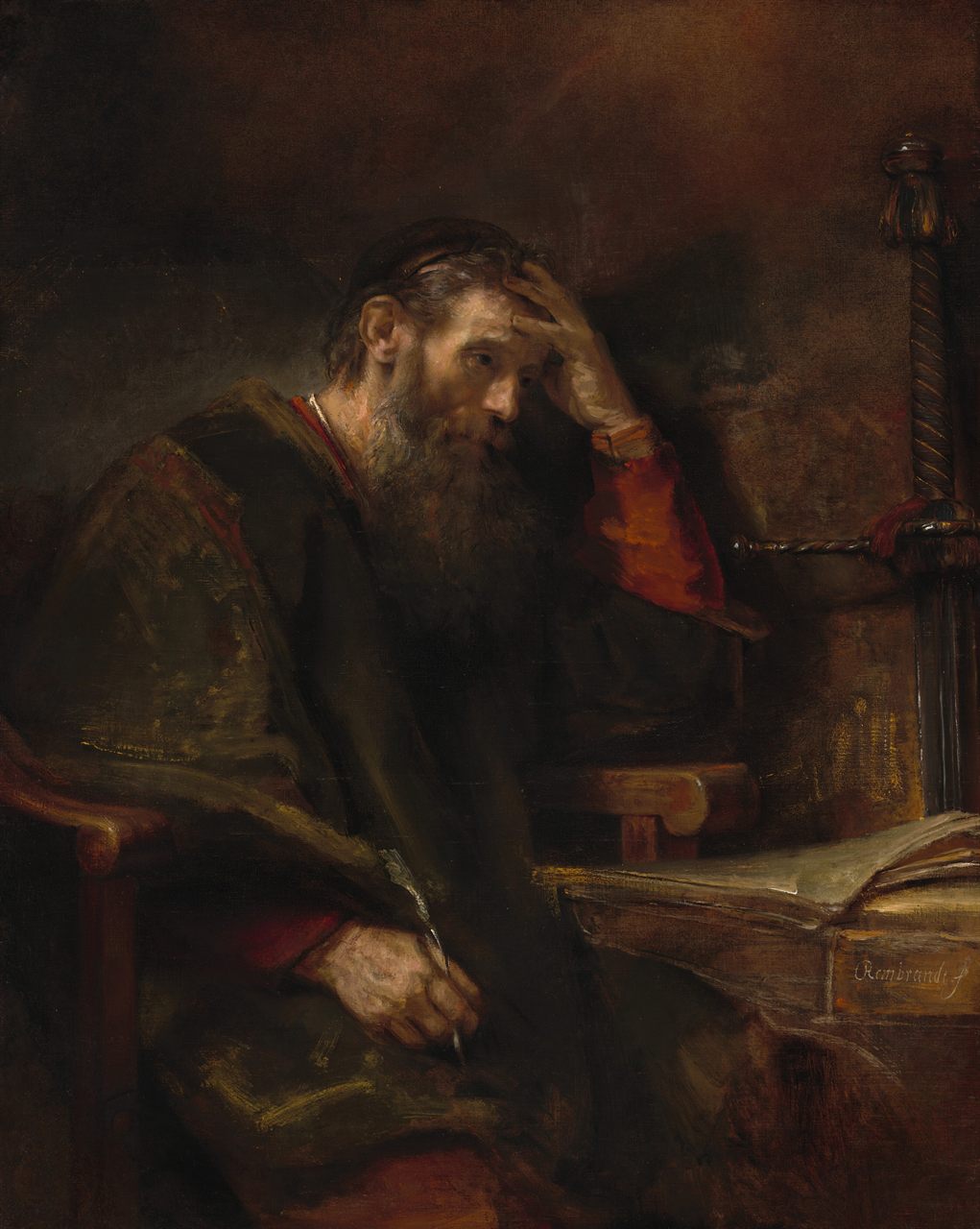
Paul the Apostle
Apostle to the Gentiles
A Pharisee from Tarsus whose letters and journeys established churches around the eastern Mediterranean and made a Gentile mission a durable part of the Christian movement.
Life at a glance
Key contributions
- Wrote the earliest surviving Christian letters, seven of them widely accepted as his
- Argued that Gentile converts need not take on full Mosaic observance
- Founded and corresponded with churches around the Aegean and eastern Mediterranean
- Set out a theology of justification by faith and of the church as one body
- Was, according to early Christian tradition, executed in Rome under Nero (c. 64/67 CE)
Notable works, inventions and offices
The undisputed epistles
Still standsSeven letters that are the earliest extant Christian documents and a primary source for first-century church life. Today: Read as scripture in Christian churches; used as historical sources for the period.
The Gentile mission as a lasting structure
TransformedA practice of admitting non-Jews without full Torah observance, argued in letters such as Galatians and Romans. Today: Remains a defining feature of most later Christian communities.
Life and career
Paul, also called Saul of Tarsus, was a Greek-speaking Jew and, by his own account, a Pharisee and a Roman citizen. The seven letters widely agreed to be his—Romans, 1 and 2 Corinthians, Galatians, Philippians, 1 Thessalonians, and Philemon—are the earliest surviving Christian writings and the main firsthand evidence for his thought.
In those letters he argues that Gentiles may belong to the churches without taking on full Mosaic observance, and that trust in Christ, not lineage or ritual status, is the basis of standing before God. He describes the assembly as one body with many members and travels a network of cities from Syria and Cilicia through Asia Minor and Greece, writing when he cannot be present.
Acts and later tradition place an earlier period in which he opposed Jesus’ followers, then a turning on the road to Damascus. Paul’s own letters speak of a revelation of Christ rather than narrating that journey in detail. The change is historically material; it is not the whole of the record he left.
He was arrested in Jerusalem, appealed to the emperor, and was taken to Rome. Early Christian writers report that he was executed there under Nero, around 64 or 67 CE. The exact year is not certain. The letters remained in circulation, were collected as scripture, and shaped later Christian teaching on law, faith, and the makeup of the church.
Legacy and impact
A written theology and a missionary pattern that made Christianity portable across the eastern Roman world.
- Questions of who belongs in a community, and on what terms, still follow the lines these letters first drew in public.
Principles and words
View of humanity
Human beings, Jew and Gentile, can be held in a single community without a single ancestral law as the ticket of admission.
How we should operate
Write clearly, travel where the work is, and measure belonging by conduct and faith rather than by origin alone.
- Standing before God does not rest on birth or ritual status alone
- A community can be one body with many members
- Teaching can travel by letter when the teacher cannot
- A mission may cross ethnic and legal boundaries without erasing them from view
“There is neither Jew nor Greek, there is neither slave nor free, there is no male and female, for you are all one in Christ Jesus.”
Sources
Every statement on this page traces to Wikipedia, Wikidata, Wikiquote, or the curated Humanity’s Atlas record. Nothing is invented. Same standard for everyone: contributions first, neutral language.