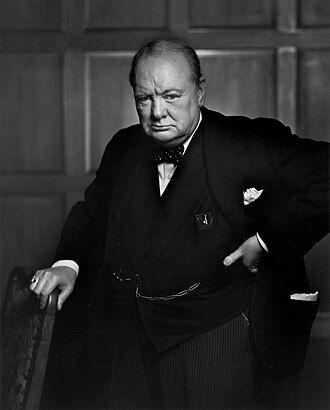
Winston Churchill
Voice of Resistance in 1940
British wartime prime minister whose leadership and rhetoric helped hold resistance against Nazi Germany in the war’s darkest early years
Life at a glance
Key contributions
- Led Britain through the critical years of World War II
- Used oratory to sustain public resolve against Nazi domination
- Helped build the Allied coalition that won the war in Europe
- Authored major historical works and won the Nobel Prize in Literature
- Framed early Cold War strategy and the idea of the ‘Iron Curtain’
Notable works, inventions and offices
Wartime coalition leadership & speeches
Living ideaRhetorical and political resistance archive. Today: Democratic crisis literature.
Life and career
Winston Churchill (1874–1965) led Britain as prime minister through the existential crisis of 1940–45, when Nazi Germany seemed poised to dominate Europe. His speeches and refusal to negotiate a humiliating peace stiffened national and Allied resolve.
A complex career included the disaster of Gallipoli, imperial attitudes, and controversial domestic policies; honesty requires the shadows beside the finest hour. Yet in 1940 his leadership mattered decisively.
He helped forge the Grand Alliance, managed wartime strategy with Roosevelt and later Stalin, and coined phrases that framed the early Cold War. Awarded the Nobel Prize in Literature for historical and oratorical writings.
His accomplishment is political and rhetorical: holding a free society’s nerve at the brink.
Legacy and impact
Proof that language and will can hold a free people in the fire.
- Authoritarian surges make 1940 a permanent case study.
Principles and words
View of humanity
Civilizations can choose surrender or costly resistance when evil organizes.
How we should operate
Prepare defenses before the crisis. Speak truth that steels without lying.
- Defy existential tyranny
- Words as wartime infrastructure
- Alliance as survival
- Resolve under bombardment
“We shall fight on the beaches… we shall never surrender.”
Sources
Every statement on this page traces to Wikipedia, Wikidata, Wikiquote, or the curated Humanity’s Atlas record. Nothing is invented. Same standard for everyone: contributions first, neutral language.