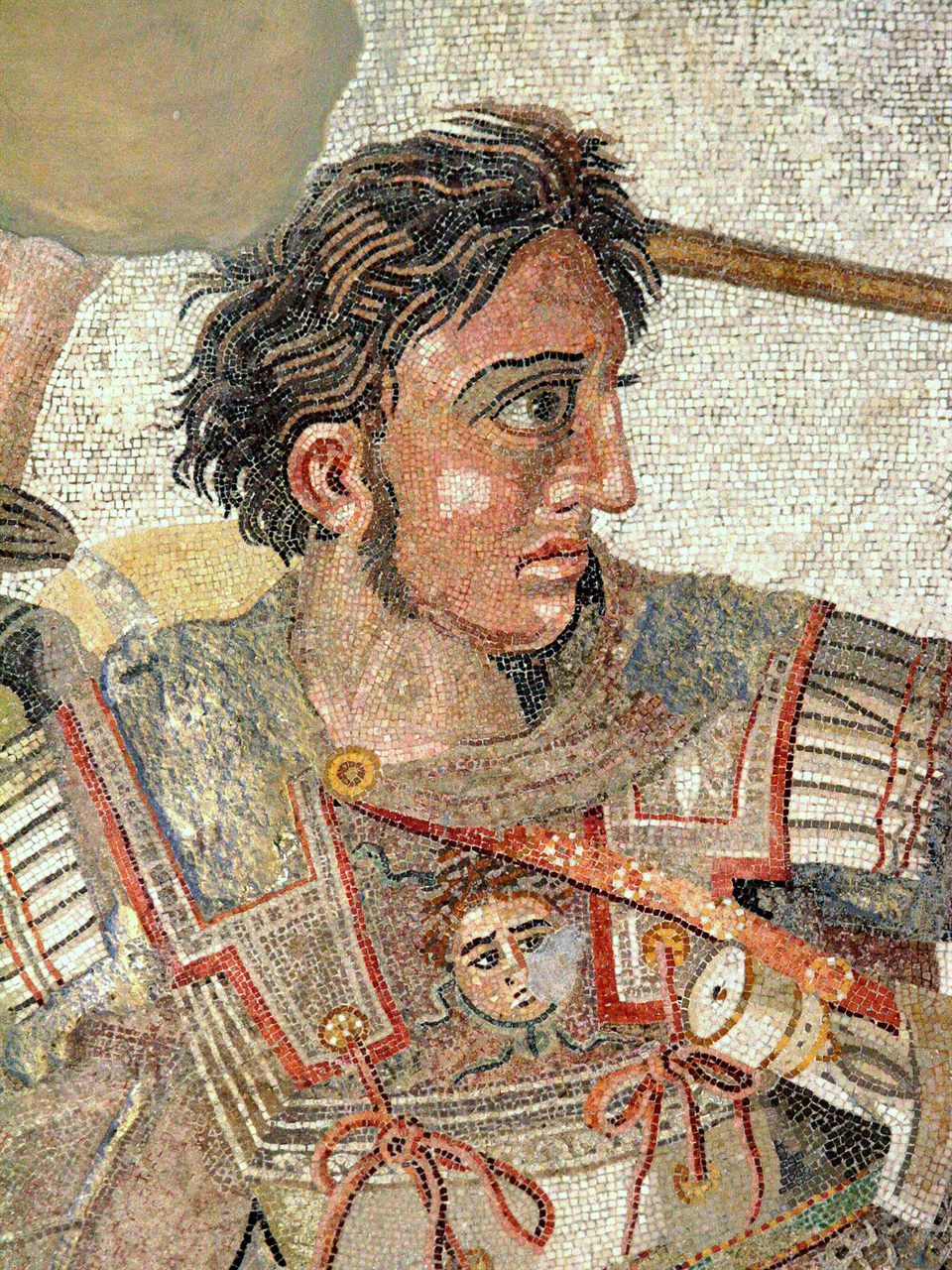
Alexander the Great
Conqueror Who Hellenized a World
Macedonian king who shattered the Persian Empire and spread Greek language and cities across three continents, creating the Hellenistic world that shaped Judaism, Christianity, and science.
Life at a glance
Key contributions
- Conquered the Persian Empire and reshaped Eurasian political maps
- Founded cities that became hubs of Hellenistic culture and learning
- Spread Greek language and institutions across a vast territory
- Enabled the cultural fusion of the Hellenistic age
- Set a lasting model of lightning strategic campaigning
Notable works, inventions and offices
Hellenistic world / Alexandria tradition
TransformedGreek-speaking urban network from Egypt to Asia. Today: Mediterranean cultural DNA.
Life and career
Alexander III of Macedon (356–323 BCE) inherited a professional army from Philip II and, before age thirty-three, toppled the Persian Empire and campaigned to the Indus. His conquests stitched Greece, Egypt, and Asia into a new political geography.
He founded cities (notably Alexandria), encouraged cultural fusion, and spread Greek language and institutions—the Hellenistic world in which science, philosophy, and trade later flourished. Brutality and vision traveled together.
Dying young in Babylon without a stable succession, he left an empire that fragmented among generals yet culturally endured. The idea of a connected oikoumene—a inhabited world of exchange—owes much to his rupture of old borders.
Alexander remains the archetype of strategic audacity and the question of whether conquest can serve civilization or only appetite.
Legacy and impact
Globalization’s ancient prototype—brilliant and brutal.
- Soft power, cultural imperialism, and city-building remain Alexander’s toolkit.
Principles and words
View of humanity
Peoples can be remixed under shared civic forms—for better and for violence.
How we should operate
When power expands, decide deliberately what culture travels with it.
- Bold strategic imagination
- Cultural fusion after conquest
- Personal leadership at the front
- Empire as vector of exchange
“There is nothing impossible to him who will try.”
Sources
Every statement on this page traces to Wikipedia, Wikidata, Wikiquote, or the curated Humanity’s Atlas record. Nothing is invented. Same standard for everyone: contributions first, neutral language.