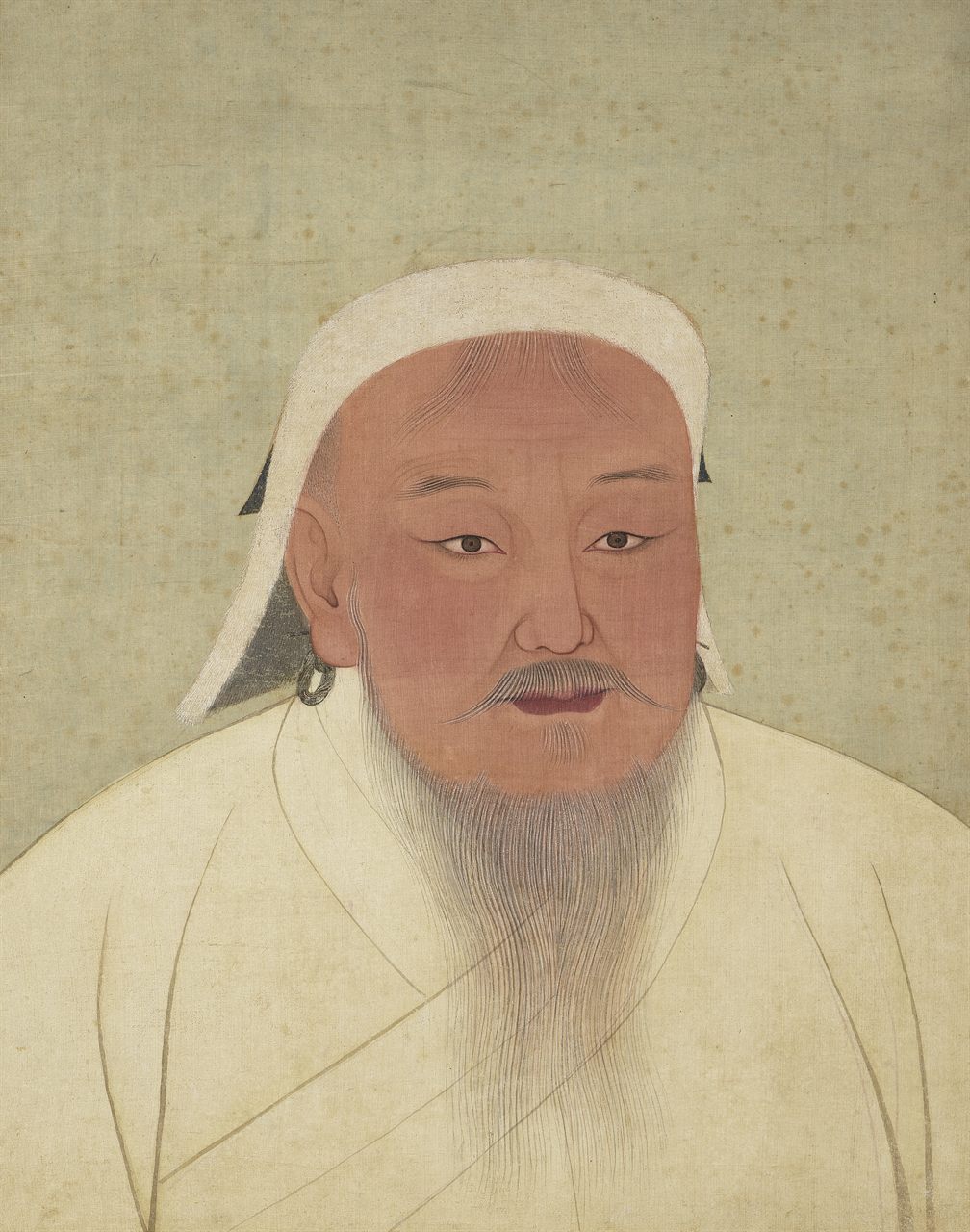
Genghis Khan
Founder of the Mongol Empire
Temüjin, later titled Chinggis Khan, unified the Mongol tribes in 1206 and built the core of an empire that, under him and his successors, spanned much of the Eurasian steppe and adjoining settled lands.
Life at a glance
Key contributions
- Unified the Mongol tribes and was proclaimed Chinggis Khan in 1206
- Organized the army on a decimal system with promotion by service
- Conquered Western Xia, large parts of the Jin realm, and the Khwarazmian Empire
- Established written orders, a postal relay, and protection for long-distance trade
- Left a succession that, under his sons and grandsons, became the largest contiguous land empire on record
Notable works, inventions and offices
The Mongol imperial army and decimal organization
TransformedA steppe military system grouped in tens, hundreds, thousands, and ten-thousands, with mixed tribal units. Today: Studied as a model of mobile command; successor states carried variants of the system west and south.
The yam relay and protected trade routes
TransformedA postal and logistics network that moved orders, envoys, and goods across long distances. Today: A foundation of the later trans-Eurasian traffic often called the Pax Mongolica.
Life and career
Temüjin was born on the Mongolian steppe, most often dated around 1162 (1155 and 1167 also appear in the sources). After a childhood marked by the killing of his father and the dispersal of his family’s following, he gathered a personal retinue, made and broke alliances among steppe lineages, and by 1206 had brought the main Mongol tribes under one command. A quriltai then proclaimed him Chinggis Khan.
He organized the army on a decimal system (arban, jaghun, mingghan, tumen) and promoted officers by service as well as by birth. Campaigns followed against the Tangut state of Western Xia, the Jin dynasty in northern China, and, after the killing of Mongol envoys, the Khwarazmian Empire in Central Asia and Iran. Those wars extended Mongol rule from the east Asian frontier into the Islamic world and were accompanied by the destruction of cities and large loss of life, which the record does not set aside.
Administration traveled with the armies: a written record in the Uyghur-Mongol script, a postal relay (yam), protection for merchants, and decrees that, among other things, exempted some religious specialists from ordinary duties. What later writers call the Yassa is hard to reconstruct as a single law book; a body of orders and custom is better attested than a surviving code.
He died in 1227 during a campaign against Western Xia. Succession passed through his sons, and under Ögedei, Möngke, and Kublai the empire reached its greatest contiguous extent, with routes of trade and communication running across Eurasia. The political center he founded is the starting point of that later map.
Legacy and impact
A unified Mongol polity whose conquests and routes tied East Asia, Central Asia, and the Middle East into one imperial field.
- How a state treats trade corridors, subject religions, and the human cost of rapid conquest remains a live political question.
Principles and words
View of humanity
Peoples of the steppe and of the sown can be held in one command if information, mobility, and law travel with the army.
How we should operate
Keep the units small enough to control, reward service, and make the roads safer for messengers and merchants than they were before.
- Command can be organized by decimal units and by recorded service
- Long-distance movement needs relays, scouts, and protected trade
- A ruler may leave local cults in place while claiming the right to tax and to levy troops
- Succession has to be settled, or an assembled empire divides
Sources
Every statement on this page traces to Wikipedia, Wikidata, Wikiquote, or the curated Humanity’s Atlas record. Nothing is invented. Same standard for everyone: contributions first, neutral language.