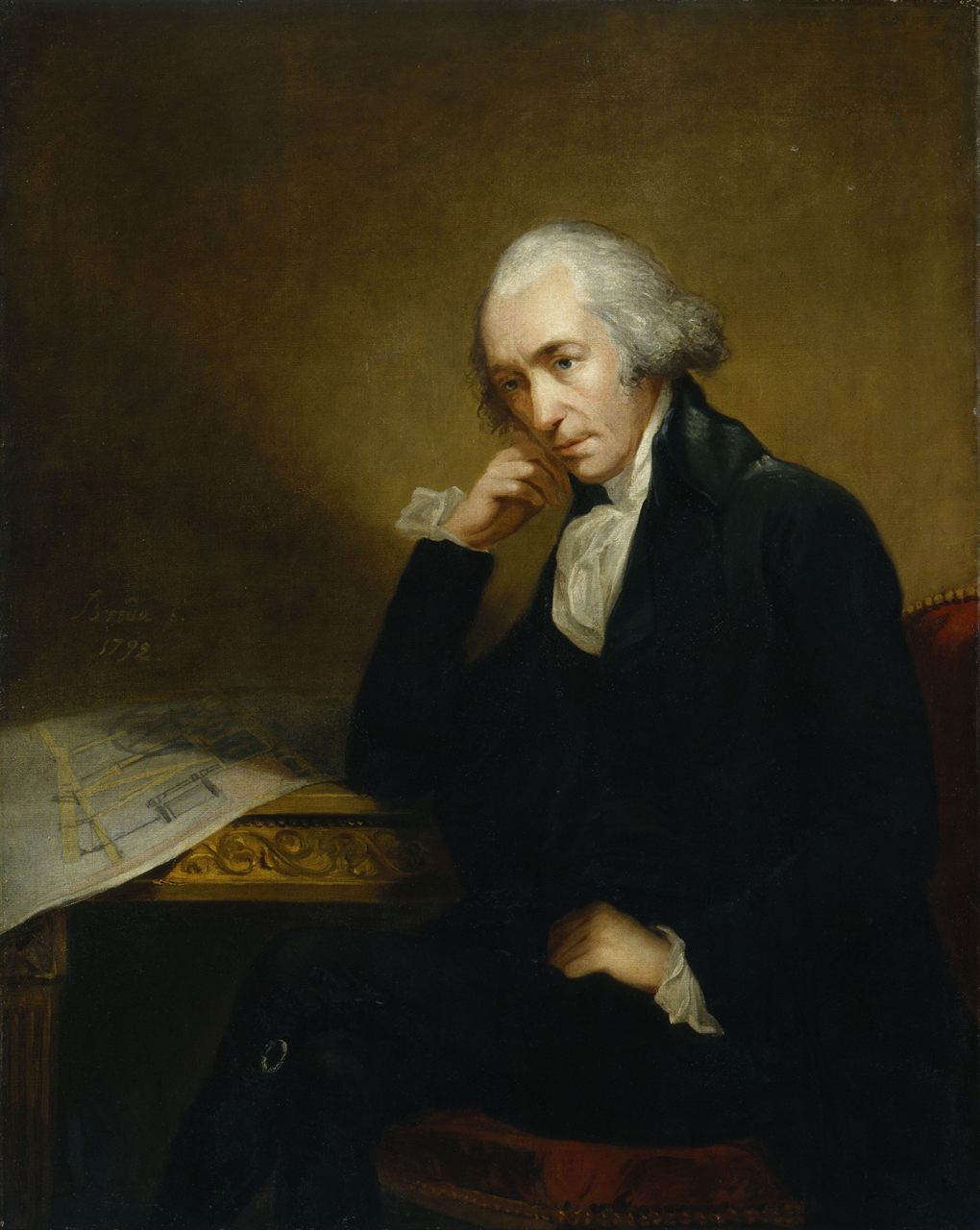
James Watt
Separate-condenser steam engine
A Scottish instrument maker and engineer who patented a separate-condenser steam engine in 1769 and, with Matthew Boulton, manufactured rotative engines that became a standard power source for mills and factories.
Life at a glance
Key contributions
- Patented the separate-condenser steam engine in 1769, reducing fuel use compared with the Newcomen engine
- With Matthew Boulton, manufactured rotative engines that powered mines, mills, and factories
- Developed the parallel motion, sun-and-planet gear, and centrifugal governor used on those engines
- Introduced horsepower as a practical unit for comparing engine output
- Was the namesake, in 1960, of the SI unit of power, the watt
Notable works, inventions and offices
The separate-condenser steam engine (patent 1769)
TransformedAn engine that condenses steam in a vessel apart from the working cylinder, cutting fuel use compared with the Newcomen type. Today: The design is a starting point for later high-pressure and rotative engines; examples survive in museums and in the technical literature.
Boulton & Watt rotative engines
TransformedManufactured engines that delivered rotary motion to mills and workshops. Today: A standard industrial power source in Britain and abroad until displaced by later engine types and by electricity.
Horsepower as a practical unit
Still standsA way of stating an engine’s output by comparison with draught animals. Today: The SI unit of power, the watt, was later named for him.
Life and career
James Watt was born in Greenock, Renfrewshire, on 19 January 1736, and trained as a maker of mathematical instruments. While repairing a model of a Newcomen atmospheric engine at the University of Glasgow in the 1760s, he identified the heat lost when the cylinder was cooled to condense steam, and designed a separate condenser so the cylinder could remain hot.
He obtained a British patent in 1769. After years of development and financial difficulty, he entered partnership with Matthew Boulton at Soho, near Birmingham, in 1775. Their firm supplied engines first for mines and then, with a rotative drive, for mills and factories. Watt also worked on the parallel motion, a sun-and-planet gear (to convert reciprocating motion into rotation while a patent on the crank was in others’ hands), a centrifugal governor, and an indicator for measuring engine performance.
He described engine output in horsepower so that buyers could compare machines. The partnership’s patents, enforced into the late 1790s, both spread and, critics argued, slowed some rival designs. Watt was a member of the Lunar Society of Birmingham. He did not invent the steam engine; he made a much more economical form of an engine already in use.
He retired from the firm around 1800, when the main patent term ended, and died at Heathfield Hall, Handsworth, on 19 August 1819. In 1960 the General Conference on Weights and Measures adopted the watt, named for him, as the SI unit of power.
Legacy and impact
A more economical steam engine, manufactured at scale, that became a common source of factory power in the industrial period.
- Industrial power still begins with the same question Watt asked of the Newcomen model: where is the energy going, and can that loss be separated out?
Principles and words
View of humanity
Natural powers can be measured, saved, and set to regular work in a factory as well as in a mine.
How we should operate
Repair the model, isolate the loss, patent the remedy if you must, and then manufacture it at a useful scale.
- Find where energy is wasted before adding more fuel
- A shop that can make many engines matters as much as a single prototype
- Name a unit so that two machines can be compared
- Improve an existing device rather than claiming to have begun the art
Sources
Every statement on this page traces to Wikipedia, Wikidata, Wikiquote, or the curated Humanity’s Atlas record. Nothing is invented. Same standard for everyone: contributions first, neutral language.