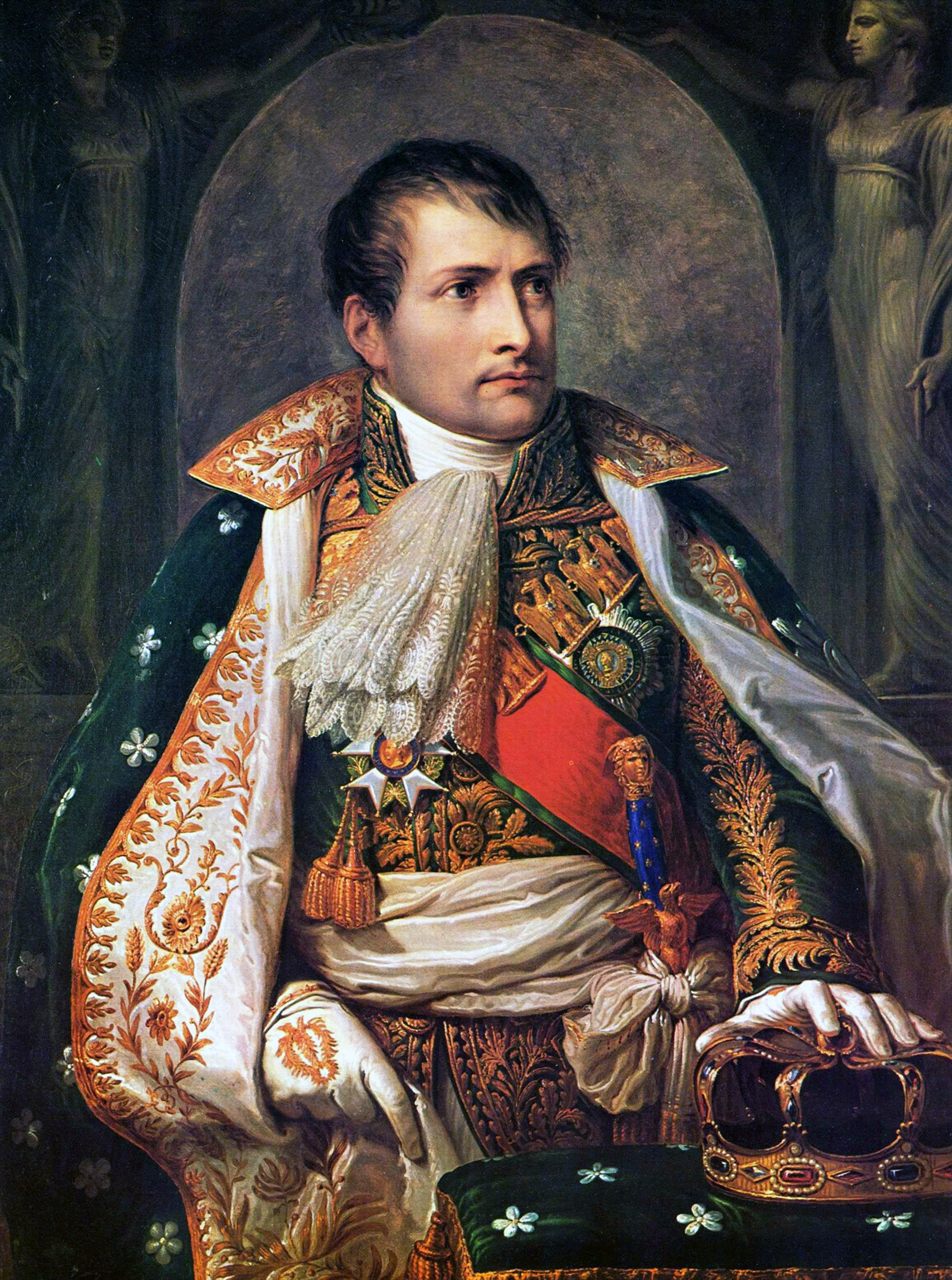
Napoleon Bonaparte
Civil Code and imperial France
A Corsican-born general who became First Consul and Emperor of the French, issued the Civil Code of 1804, reorganized French administration, and fought a series of wars that redrew the map of Europe.
Life at a glance
Key contributions
- Promulgated the Civil Code of 1804, which shaped civil law in France and in many later codes
- Reorganized French administration, public education (lycées), and finance (Bank of France, 1800)
- Negotiated the Concordat of 1801 between the French state and the papacy
- Commanded French armies through the Revolutionary and Napoleonic Wars, redrawing European borders
- Was defeated in 1815 and died in exile on Saint Helena on 5 May 1821
Notable works, inventions and offices
The Civil Code of 1804
Still standsA comprehensive statute of civil law on persons, property, and obligations. Today: Still the core of French civil law, as amended; ancestor of many civil-law codes in Europe and beyond.
Prefects, lycées, and the Bank of France
Still standsA centralized administrative, educational, and financial apparatus created in the Consulate and Empire. Today: Prefects, the lycée system, and the Bank of France remain institutions of the French state.
The Concordat of 1801
TransformedAn agreement with Pope Pius VII that reopened legal Catholic worship in France under state oversight. Today: Set a pattern of state–church settlement later revised in 1905.
Life and career
Napoleon Bonaparte was born in Ajaccio, Corsica, on 15 August 1769, shortly after the island passed to France. Trained as an artillery officer, he rose during the French Revolutionary Wars, took power in the coup of 18 Brumaire (1799), and governed as First Consul, then, from 1804, as Emperor of the French.
The Civil Code (promulgated 1804) fixed a single written law of persons, property, and contract for France: civil equality for male citizens, secular civil status, and strong protection of property. It was imposed or imitated in much of Europe and later in legal systems outside Europe. In the same years he created the Bank of France (1800), lycées, the Legion of Honour, a centralized prefectural administration, and, in 1801, the Concordat with the papacy.
The Napoleonic Wars extended French control over large parts of the continent and ended in defeat: the retreat from Russia in 1812, abdication in 1814, a return in the Hundred Days, and Waterloo in 1815. The campaigns caused mass death and displacement. In 1802 he also restored slavery in French colonies where the revolutionary government had abolished it. Both facts belong in the record of the same career that produced the Code.
Exiled first to Elba and then to Saint Helena, he died there on 5 May 1821. The Code, the administrative map of France, and the legal idea of a uniform civil statute remained after the empire did not.
Legacy and impact
A written civil-law model and a centralized administrative state that outlasted the empire that issued them.
- Legal systems still choose between a single written civil code and case-based common law; the 1804 Code is one origin of that choice.
Principles and words
View of humanity
Citizens can be equal before a published code even when political power is concentrated in one office.
How we should operate
Write the law down, train the people who apply it, and keep civil status in the hands of the state.
- Civil law should be written, uniform, and publicly known
- Administration can be trained and posted rather than inherited
- A state may settle with a church without making the church the source of civil status
- Military success does not, by itself, settle the legitimacy of a legal order
Sources
Every statement on this page traces to Wikipedia, Wikidata, Wikiquote, or the curated Humanity’s Atlas record. Nothing is invented. Same standard for everyone: contributions first, neutral language.